
Last Updated on 2022-12-22
Lumbering on the Nashwaak in the 1800’s and early 1900’s
Excerpts (edited) from “Lumbering on the Nashwaak”, by Marilyn J. Evans (self-published 1995?)
The Black Watch together with Loyalists were likely the first Europeans to settle permanently in numbers along the Nashwaak. Although granted land for farming and lumbering, the settlers were prohibited from cutting the large pine which grew all along the Nashwaak. It was required for ships masts, particularly for the British navy. Acts were passed in England forbidding the cutting of pine trees 12 inches or more in diameter. These were thus reserved for the Crown. After the end of the war with Napoleon, demand for pine was reduced and the settlers were free to cut on their own land and bid for leases to cut on Crown land. The lumber industry became a key part of the Nashwaak economy.
Monty Webster — ” During the Napoleonic wars 1794–1814, timber was in great demand for warships, and cities of industrial Britain were expanding rapidly creating a further market for colonial pine for interior decorating. England’s pine lumber acts applied to all land granted or ungranted. “The King’s man” or surveyor of woods, had the right to seize the pine from land owners, and it was not until 1817 that privileges for cutting on private lands was relaxed and restraints lifted enabling everyone to cut pine on their own land.”
The lumberman knew how to make a profit. Knowing how much lumber he wanted to cut in the coming season, he calculates the number of men he needs to get x number of logs, and knowing from experience how much food is required, provided accordingly. The lumberman also calculated the length of the haul and provided the necessary number of teams and provisions for them as well. During the latter part of October and after their fall home chores were cleaned up, the men went off to work in the woods, some not returning until March. For the young men, cutting timber was more exciting than staying at home with the women folk to carry on the farm chores. By the time the sons of the first pioneers reached their early manhood the lumbering industry was beginning to open up. Boys in their early teens with the down of youth starting on their faces marched off with their fathers for their first winter in the woods. They were apprenticed to more mature men, some of them little older than themselves. They took great delight in showing off their know-how, and ability, by making ready sport of the newcomer.
Archibald McLean and his sons hauled pine timbers from the Gains River country to the Nashwaak with oxen, on a road below where Bill Wyton of Taymouth lives today. These pine timbers were required by the British Admiralty, and were vital to their navy. The timbers not used as ships masts were used as construction timber. It was hewed square with a broad-axe, or if the job was small an ordinary single or double bitted axe could be used.
Bill Wyton: The McLeans hauled logs 100 to 120 feet long and four feet across the butt; pine, that’s the kind of wood they had in those days. It was virgin, virgin country and they were chopped down, cut down, and then a cross was put on them, by a man who came from the government, the King’s Man they called him. He put a cross on the pine that he thought would be suitable for ships’ masts”.
The older generation was highly skilled with the axe, and it was one of their most prized possessions. It was not until later years ( around the 1880’s] that the crosscut saw was used. The first men into the woods in the fall were the Cruisers; they would go into the woods before the snow began to fly to locate and arrange the camp and the winter’s scene of operations. They took their kit bags or, as it was commonly called, their ” turkey “, which usually contained an extra pair of pants, 2 or 3 pairs of socks, a ball of yarn, a darning needle, thread, buttons, salve, home made cough medicine, horse-hide shoe packs for cold weather, and cow-hide shoe packs for wet weather.
Martin Cass: In the age of the ox and horses one little-heard of part of the lumber business was a small but important handful of men: The Cruisers, who went into the unexplored forest and estimated how much prime lumber could be harvested from a particular lease, and with the cruiser was a man who knew how to plan where the roads would be, how to avoid uphill grades and how to take advantage of every down hill. Sometimes not the shortest route but the easiest for the heavily loaded animals. Today the modern lumber machines make this less important. Two well known Cruisers were Tom Cass and longtime friend Dan Stewart; these men were famous for their lumbering know-how.
When the Cruisers reached the area where they decided to cut, they set up camp. Six or seven men from the lumbering party (Choppers and Knotters) with axes, and who knew what they were doing, commenced to clearing away a few of the trees, and began building a log camp. They placed the logs one on top of the other, and caulking with sphagnum moss; the bark was left on, but the limbs were removed. Next they cut in the door, putting plank on the sides of the hole and a header at the top. Only after the camp was built, would they build a horse hovel. The camps were built in two separate log buildings, in line with a covered “dingle” between. One section was the cook house and the other the bunk house. The dingle was a roofed over section. It was in this dingle (shed) that barrels of salt pork, sides of beef, as well as quintals of Codfish were kept. A quintal was a 112 Ib. bundle of whole dried salt cod, with the skin on. These sides were called ” flakes”. Once the camp had been established the main road and branch roads were decided upon and cleared of trees and logs. Skid sand levers were then prepared, and banking places selected and cleared.
After 1850 the lumber camps had a cookstove, and in some camps, two stoves hooked together, side by side , with a boiler over top for heating water. Here the cook was the final authority, subject of course, to general orders from the “Boss”. The cook had to keep the fires going all night, and he began his day at 3:00; at this time he would rise and begin preparing breakfast, then at 4:00 either he or his “cookie” would go to the bunkhouse to shake the ” teamsters” awake. After he had fed the teamsters he would again go into the bunkhouse, this time to holler ” ROLL OUT ” thus starting the men’s day in the logging camp. The men would get dressed, and wash up, and then set down to a breakfast of oatmeal porridge, toast, sausage, potatoes, bread, butter, sugar, molasses, tea, coffee, milk and cheese. No one lingered at the table; you ate, then left, heading for the woods to begin work.
It was brutal hard work, hour after hour, day after day, cutting trees by hand. Some axe handles would be stained red, after a man’s hands had broken open. The lumber woods was no place for a weakling, and only the toughest remained through the winter. First lunch would be around 9:00; it was taken to the men in the woods, usually consisting of pork and beans, camp bread, butter, molasses cookies, molasses cake, tea, and coffee. Second lunch was at 2:00- if not pork and beans then it would be stew, dough boys, camp bread, butter, muffins or molasses cake. Then when their work day was done, they returned to camp, usually around 7:30, and supper would be ready for them, a typical meal would be: Pot roast, mashed potatoes, camp bread, biscuits, apple pie, ginger cake, molasses cake, sugar, butter, gravy, tea, coffee, and milk. One of the best cooks on the Nashwaak was Richard (‘pickle’) Evans. Richard would go and stay in the camp until Christmas. At that time he would come home to be with his family, then after Christmas return to camp until shut down. Malcolm Evans, his son, started working with his father as cookie when he was 13 rears old, around the year 1922.
Neither Richard Evans or his son Malcolm used a recipe for camp bread, it was all done from memory and feel. The dough which they called sponge bread, was set late in the afternoon, than heated in a barrel with a lamp under it over night, they would let it rise until about 1:00 AM at which time they would get up and knead it. It would be ready to cook then serve at 4:00. Along with making bread, cakes, pies, and 4 meals a day the cook was responsible for the camp fires. Cooks on the Nashwaak: Richard ( Dickie)Evans, Malcolm Evans, Lorne Bubar, Perce Gilmore, Ban Stewart, Harry Hamilton, Edgar Wade, Hose Allen, Jim Urquhart, and Joe Berrio.
CHOPPERS and KNOTTERS — As mentioned before some of the first men into the woods were the choppers and knotters. It was the choppers duty to fell the trees and chop them into 14 to 20 foot lengths with a diameter of 12″ at the top. The knotters duty was to cut off the limbs, and chop two holes, opposite each other at the end of the log, so that grips could be inserted by the skidders who yarded them out to the main pile, with their horses. Now these holes were naturally called grip holes. The young lad on his first day out, was usually made the bunt of some joke, such as sending him forth, from one crew to another, to try to borrow a set of grip holes. If the young man was wise, he would take all such jokes in good part; the young man who couldn’t take a joke was sure to be the recipient of many. After the trees were felled, and limbed, they were trekked to the main yard by a skidding gang. This gang worked a day behind the axe men. It could be dangerous to both horse and man if the skidding crew worked to close to the cutters. The skidding horses wore a harness of bells, so the cutters could hear them coming, and the cutters called a warning ” Timber” when their tree began to fall. The other men who would have to hear these warnings were the swampers, the men clearing pathways, so the skidding crew could get the logs out. The skidding crew would pile the lumber on skidways in the main yard to await the winter sleigh haul. It also made it handy for the scalers and the tally man to do their jobs. They would come along and mark the ends of the logs. Each lumber company had their own distinguishing mark, be it one dot, or two dots, whatever. No two companies ever had the same mark, so everyone knew their logs. Samuel Craig of Zionville was a scaler for quite a number of years for the Nashwaak area. He was a well liked and respected man. As a scaler, he had to ensure that if he scaled a million feet in the woods they would get a million feet when they sawed it at the mill. And while some scalers were not very popular with the lumber bosses, because of fear they might be cutting down on their profits, Sam could be counted on to deliver a fair honest tally. The marked logs after scaling would now sit in the yard until January. Bob Craig and Angus Edney, were also scalers on the Nashwaak.
THE BOB SLED HAUL : During the iron cold days of January, the TEAMSTERS, began their haul to the frozen river beds. Their loads would be hauled over ” ice roads.” These roads had a level centre section, with two deep troughs on either side so the sleigh would not slide off. At night time, there would be some man picked out of the crowd who had a good team; they would put him icing the roads. That was one of the most miserable jobs ever invented. He would get a set of bob-sleds, rig up a big box affair that would be 12 feet long, six feet high and eight feet wide. It was made of two inch thick tongue and groove plank. That box would be fastened to the bob-sled so it would not tip. Then line and tackle, with a barrel, and hooked to a horse, were used to load the box full of brook water. At the end of the box (tub), they had a two inch auger hole with a wooden peg inserted, so it would not loose water. The wooden peg had a strap attached to it with a nail, and the other end fastened to the box. This was so the plug would hang to the box, and not fall to the ground and get lost. The water came out with such a force sometimes, that before the man could get away, he was sprayed from head to foot, and this would be in temperatures of thirty to thirty five below zero. He would work all night, spraying the water into the tracks; it would freeze and by morning you could skate on it.
The boss wanted the roads icy so they could haul the heavy lumber loads; at times they would get 40 logs on a load, and those big loads would slide along with ease.” On steep hills and down — grades however, the boss would send a man to sand, so that the timber loads would not slide downhill too fast and upset. ” Road Monkeys” were the men who were hired to keep these roads free of limbs, bark , horse manure, anything that night effect the smooth icy surface.
In January, the Teamsters began their long hauls; at 4:00 the cook would shake them awake, they would breakfast, then harness and feed their horses by lantern light. The horses would wear bells on their harness, and you could hear them jingle as the horses thundered down the icy road. Teamsters risked their lives going down those roads at thirty and forty minute intervals, only about a half hour behind their head team. The horses would be going full speed ahead, and the teamster sitting on top his load, would be hoping the team ahead had stayed on the tracks, and not lost his load on the icy roads. Teamsters would load their bob-sleds,eight feet high by ten foot wide and trek along the roads to the frozen river beds, where the logs were put on a ‘brow’ of a river bank. Up to 10,000 pieces would be piled, stacked , on what they referred to as a “landing”, waiting for the spring thaw. The work day for the men in the lumber crews, began around 4:00 in the morning,and but for two lunch breaks remained steady until 7:30, when they would returnfor supper. After supper the men would return to the bunkhouse.
THE BUNKHOUSE: Across this building on two sides and at some camps across one end, were shelves made of poles. The bottom shelf two feet from the floor and the top shelf three feet above. These shelves were covered with straw or fir boughs, and covered with a blanket about thirty feet long, to form a long mattress. On this the men slept, feet out, with one, or sometimes two, long blankets over them, running the whole length of thebunks, upper and lower. With the exception of moccasins and mackinaws, most men slept in their clothes. Baths were not a common occurrence. One big stove, usually taking a four foot stick of hardwood supplied heat. Along the front of the lower bunk, a long seat made of hewed timber ran the length of the bunks. It was known as the ” Deacon Seat”. The boss would also keep in the camp what was known as a “wangan box”, this box contained: socks,mitts, humphrey pants, shoe packs, chewing tobacco, scissors, thread, yarn, needles, whetstones, moccasins, and buttons. These items could be drawn by the men and charged against their pay. Most employers made a good profit on the deal. After the camp had been occupied for a short time, you would notice the atmosphere becoming rather thick, it was a combination of body odours, wood and tobacco smoke, pitch, as well as wet woollen clothing that was hanging by the stove to dry. Malcolm Evans said you would open the door and swim in, and after a while you would not even notice it. Every camp had a boss the ” foreman” to tell the various crews what to do. However some people would say the cook was the most important person in the camp. If the cook was good, the workers were happy, and would work hard and do their job well. If the cook was poor, the crew would not be as happy and like as not, not work as well as they could.
The camps were in good condition, but each year, someone would manage;-to bring lice to camp, and everyone became lousy. Ken Dunphy mentioned a powder he and some of the other men took, to put on their blankets and cloths to ward of lice; he couldn’t remember the name of the powder, but it could have been boric acid, as it was used in England for that purpose. It was customary, when the men came home in the spring, to strip in the outside shed or just inside the door and pass all their clothing in to be dropped into a boiler of boiling water. After that a bath behind the kitchen stove. They were now fit to join their family. With the approach of night the woods became silent. The teamsters were always the last to enter the cabin and could feel the wind as they attended to their horses, before joining the others for supper. After supper each man did his last minute chores, darning a sock, sharpening his axe if necessary then settled down for the evening’s entertainment. Entertainment consisted of arm wrestling, fiddle music, camp songs, storytelling, and in one camp, the crew made a checker board. They cut up a branch to make the checkers, marking one side, next they drew up the checker board on the deacons bench. The boss would walk over to the lantern at 9:00, and turn it down. This was the sign for quiet, and the camp would settle to sleep. The snoring was terrible; with bunks all around the room, there was quite a sing song of snoring, and there always seemed to be some old fellow who couldn’t sleep, and he would be up tramping around the room. At the end of winter, the end of ” the lumber season ” the teams and teamsters would depart for home; their job would start again in the fall. The men that were left would run the drive.
RIVER DRIVE: There was usually only five to six weeks between the end of the lumber season and the log drive. From the Nashwaak Lake to Stanley there were about eight dams built in the river, plus one or two sluice-ways. When the water level lowered, these gates in the dams would be lowered to retain the water. After raising the water level, the gates would then be raised and the water and logs would flow freely. Some refer to this as “drive by flood”
LOGGING DAMS by Martin Cass: “The number of people who remember the Logging methods of our pioneer lumberman are getting less and less each year, especially those who remember the use of “logging ” dams. If they think of them at all it is as good places for fishing during the summer and to skate during the winter. Though most of the old dams are only memories, there is usually enough of the ponds left for this. Below the dam gates, where the water gushed through the gates or spillways, was always worn away by the force of the water to a depth of several feet and is shaded by the floor of the spillway, which is usually the last to rot away, as the water protects the wood. In most cases the purpose of the dam was to aid in the floating of the fall and winter cut lumber, after the spring runoff, when more water was needed. The dam gates were closed in the late afternoon as it would not effect the logs which were still floating a mile or more down stream. The rate of drop of each stream governed the time it took for the water to reach where it was needed. In many cases there would be more than one dam on the river or on other streams emptying into the main stream. The gates of these dams would be opened to keep the water level up as the water from the main dam was getting low. At times there were several dams supplying water, the gate of each being opened at carefully arranged times to keep the daytime level of the water floating the logs. It seems man selected his dam-sites much as did the beaver. They required a large, wide area of the valley, capable of holding a great deal of water, but with an area of higher banks where the dam was built. It took several hours for the water level of a large dam to drop beyond being useful. When the water did reach that level the dam was closed to catch a supply for the next day. Then another dam was opened. From this developed the saying “Putting on Steam” as is called the starting up of our modern plants today. These fast rise and falls of water often caught people on the wrong side of a stream, with nothing they could do but wait or travel miles to get to the other side. An example of this water control can be seen by noting the placement of the dan on the upper McKenzie and the upper and lower dams on the Young’s Brook and the one near the Nashwaak at Nashwaak Bridge above the highway road on the McCollum’s creek. There are other dams further up the Nashwaak, one of them at the spillway of a lake, which is capable of storing a great amount of water.”
THE WHITE WATER MEN: Around the last of April and the first of May, when the snow had gone from the ground, and the ice ran, the men proceeded to walk up the shores of the Nashwaak. Their destination, the head of the River, to begin the log drive. There was companionship, and camaraderie among these men; the work was hard and wet, the pay was not good, and at times the job was dangerous. But they liked the challenge of combatting the rocks, and the full roaring waters of the Nashwaak in spring, and with their courage and skill, their acquired art of standing on, and riding, a 14 to 20 foot length of log down her swift narrow passage ways. About 200 men would walk towards the head of the Nashwaak; 30 men would stop at the lower Nashwaak Lake, 90 more at the Narrows, 30 more at Barkers Dam, 90 at the Sisters, and 30 at Governors Brook. The rest would be at the Upper Lake. If the Upper Lake was still solid with ice, they would have to blow it with dynamite, and then start the logs down the Nashwaak. The Spring drive has now begun.
Martin Cass: Stream Drivers started their drives as soon as the streams were free of ice. Sometimes building floating booms to hold the logs from going over farmland down river, then turning the logs loose as soon as the freshet lowered. The ice in the lakes often had to be blown, near the gates the faster water was easily cleared, then two men would take a small boat with caps and a supply of dynamite of which one stick or even only 1/2 stick of explosives was used. This charge was pushed under the ice and upstream. The explosive was fused to give time to allow the placing of the “shot”. Once Gordon Cass and Ernie Gallagher had a “shot” come loose from the pole; it drifted back under the boat and exploded “midship”, goodbye boat. Fellow lumbermen came to the rescue and pulled Gordon and Ernie from the icy Nashwaak River.
There was a ” pecking order ” among the river men:
I. White Water Men — The top head drivers, these men were skilled at riding logs through rapids, or breaking log jams; they had natural balance and agility.
2. Good Drivers
3. Sackers — those who sacked the logs that lay on shore, to the edge of the river.
4. Lunch Carriers — usually a young lad in his teens, who carried the lunches from one crew to another, skirting in and out, around the edges of the river, often carrying great loads upon his back.
The White Water men: — To this day names of the top drivers can be heard, whenever old timers get together. You’ll hear names like: Wild Bill McPherson, sometimes called Jesse James, Bunty Bill Stewart, his son Bruce Stewart, Frank Banks, Jimmy Pond, and Bill Whittler. These were the elite of the white water men. They could ride a log through the roughest water, or leap from one log to another in mid stream, without losing their balance, their peavys or cant-hooks. These were all Nashwaak Men.
If there was a log jam, it was a white water man who was chosen to go out and break it up. Say, for example, a log went cross ways ( a key log), other logs would build up behind it, until they were built up like a dam of logs across the river. The water behind would build up higher, and higher, and the water in front would be shallow. So the best drivers, the Whitewater men, would be sent out there, because they would have a better chance of getting back to shore again alive.
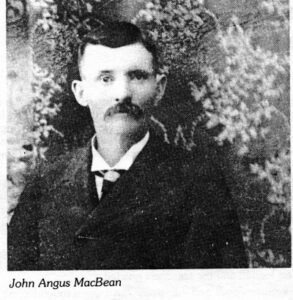
The Death of John MacBean: John Robert MacBean (also known as John Angus MacBean) was a well-known log driver and white water man. He was crushed to death in a lumbering accident while driving logs down the Nashwaak (April 1903). According to press reports, he died terribly. Over 100 logs rolled over his body before he could be pulled from the river. Although most of his bones were crushed, he lived for several hours afterwards. Marilyn J. Evans, in her book “Lumbering on the Nashwaak” (privately published about 1995), quotes Glenn E. Pond -
“the landing (the log jam) was straight up and down, a perpendicular deal, and the men were afraid of it and wouldn’t break it in. John Angus was fearless and expected the men to do as he told them. He was in a bad mood when he found the men all standing around. He said “If none of you have got guts enough I’ll do it myself”. He jumped out on the logs and one man, Bunty Bill Stewart, went out behind him. He said “John Angus if you’re on your way to Hell I’ll go with you. But it’s a piece of foolishness”. He jumped out on the landing with John Angus; they worked just two logs when it gave, and straight down they went to the bottom. The logs nail-kegged end over end; John Angus broke every bone in his body. Bunty Bill Stewart went down through with him and never got a scratch, no one knows how, but Bunty Bill escaped unharmed. That was one of the biggest funerals held on the Nashwaak. Sixty teams of horses came from all over, started forming up in Lower Durham, Upper Durham, everywhere.”
As the river widened, the log drive continued down the Nashwaak to the Saint John River.
From the Provincial Archives of New Brunswick
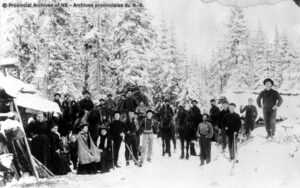
Logging-Camp-Winter-P51-38.jpg
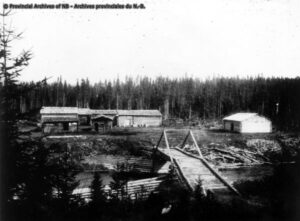
Logging-camp-Kedgwick-1916-PANB-P2-147.jpg
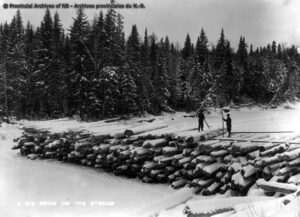
Log-drive-P11-77.jpg